
Not Just Models, but Meaning
The End of the One-Engine Mindset
For years, we assumed the future of AI and data would be decided by scale — the biggest model, the fastest engine, the most powerful stack. It was a race toward raw horsepower.
But that race leads to exhaustion, not clarity.
What’s quietly emerging is a different future. One where multiple systems of intelligence — each with their own perspective — don’t compete, they collaborate.
In this world:
- Data and metadata don’t just inform — they work together.
- Rules engines, large language models (LLMs), and behavioral analytics each bring their own logic.
- Conformed dimensions, ontologies, and decision frameworks serve as the glue, not the edges.
And in that harmony, something profoundly meaningful takes shape.
Intelligence That Doesn’t Stand Alone
Every intelligence system has its strengths — and its limits.
- LLMs bring language fluency and wide contextual reach — but lack precision, continuity, and auditability.
- Rules engines offer determinism and repeatability — but can’t generate intuition or explore edge cases.
- Metadata catalogs offer lineage, structure, and trust — but sit inert without interpretation.
- Historical data tells us what happened — but not what to do next.
Individually, these are useful.
Together, they become powerful.
We’re no longer seeking a single “source of truth.”
We’re learning how to compose intelligences — like instruments in a well-led symphony.
The Power of Composability
This isn’t just about integration. It’s not more ETL or tighter APIs.
This is composability of intelligence:
- A rules engine invokes an LLM when nuance is needed.
- A behavioral trigger activates both a predictive model and a Recommended Action.
- Metadata frames the context — ensuring guidance doesn’t drift from purpose.
- Systems query one another not because they must — but because they trust each other’s answers.
It’s not one system dominating.
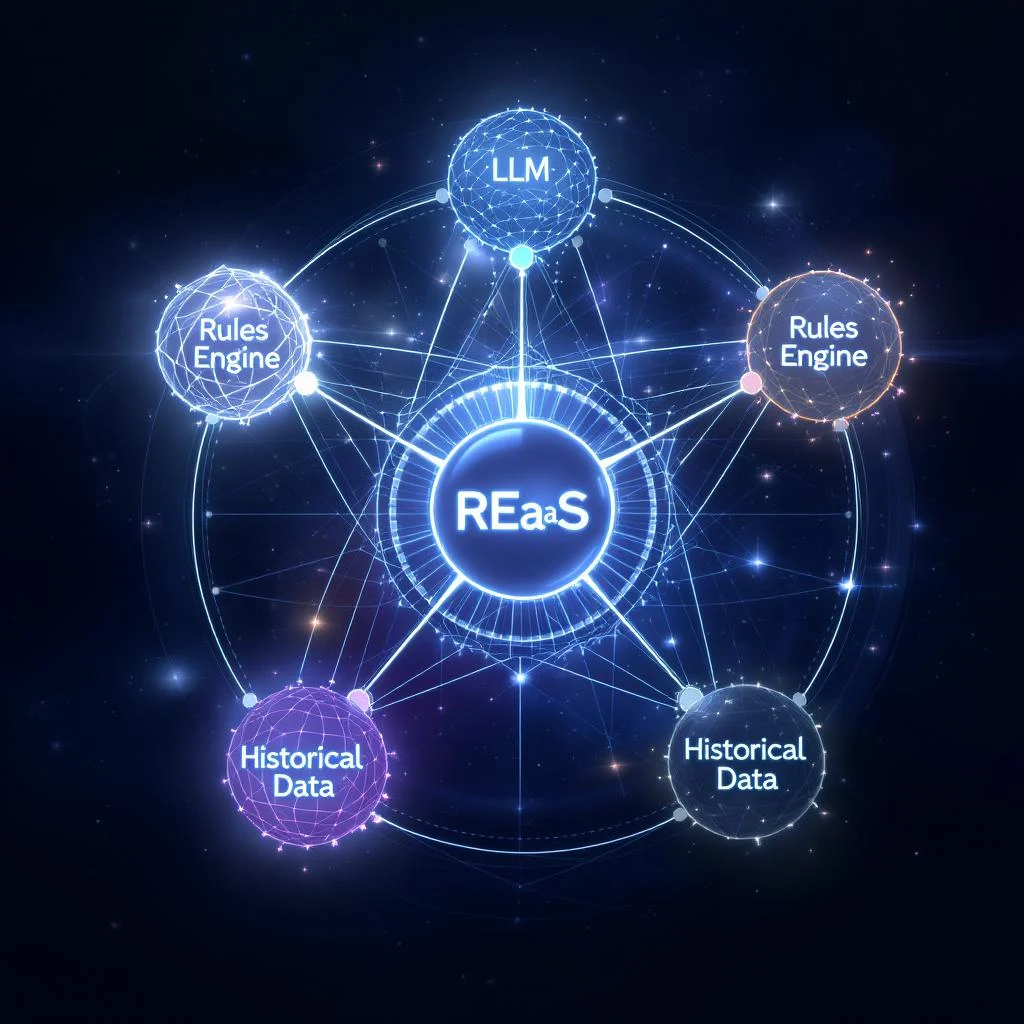
It’s a network of logic, where each node plays to its strengths and learns from the others.
Why This Matters Now
The real world is not neat. It’s fragmented, noisy, cross-channel, and deeply human.
No single model will ever be enough to navigate:
- A customer switching roles while browsing financial products.
- A fraud signal that appears clean in isolation but odd when stitched over time.
- A community showing subtle behavioral shifts long before a trendline appears.
These are problems of perspective, not horsepower.
Only by teaming intelligence systems can we respond with both scale and grace.
The Role of REaaS and Recommended Actions
In this architecture, REaaS becomes the logic conductor — orchestrating how and when systems interact based on events, patterns, and thresholds.
Recommended Actions are the language that connects everything. They translate insights into steps, judgment into action.
Imagine this flow:
- A model detects risk.
- A rules engine confirms behavioral drift.
- Metadata narrows the cohort.
- The RA communicates what to do — in a form that makes sense to a human, within the systems they already use.
This isn’t just collaboration — it’s intelligent orchestration.
Thinking Together, Not Just Working Together
The goal isn’t to centralize all intelligence.
It’s to enable systems that think together.
- Not AI supremacy — but AI symphony.
- Not dashboards to admire — but decisions that move.
Not a black box — but a network of logic, memory, judgment, and care.